Sustainable living in Portugal
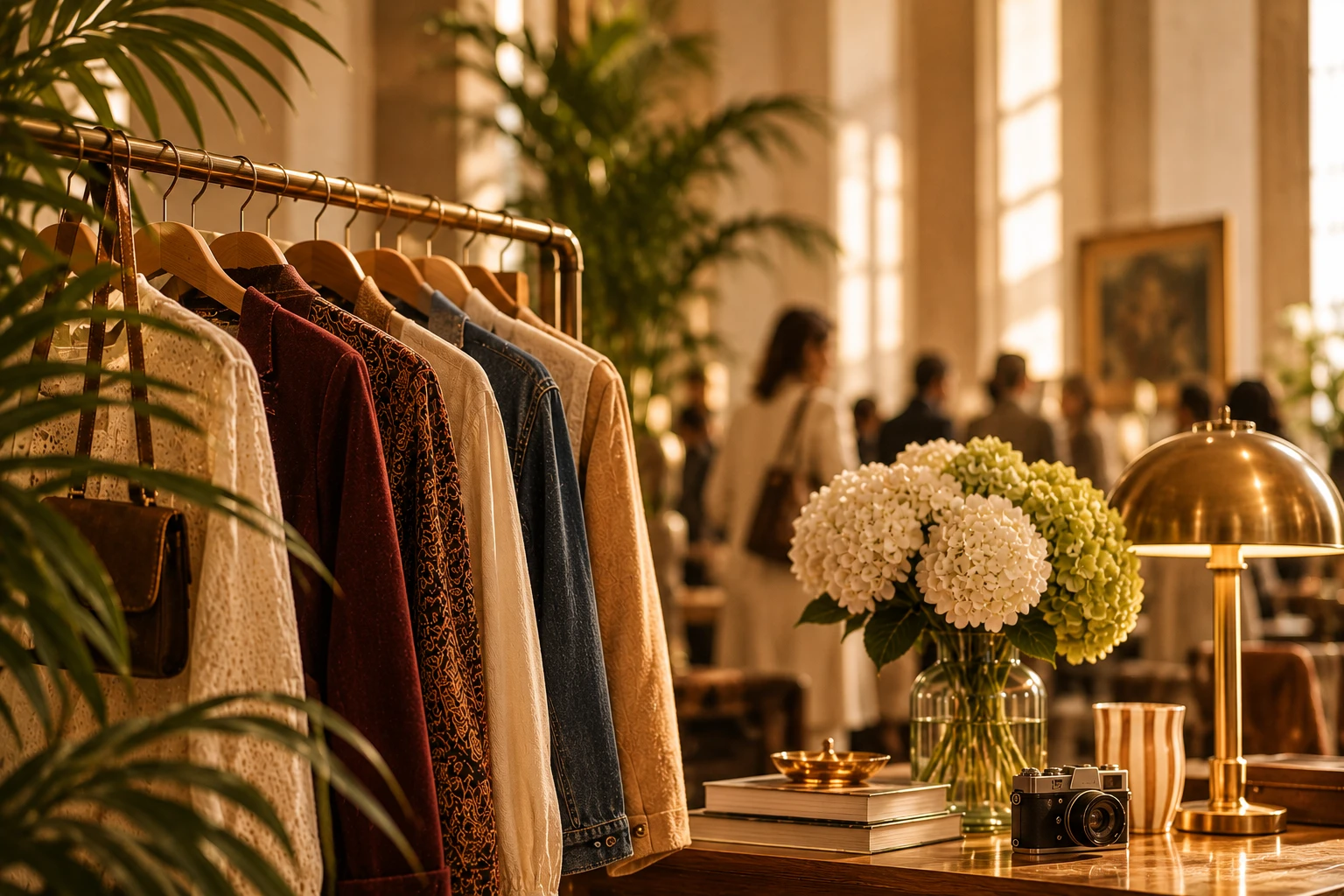
When the circular economy checks in: Vintage market at Hotel Roma
A second-hand market inside a hotel? I spoke to Joana Marto Almeida about the Vintage Market at Hotel Roma, in Lisbon.

A second-hand market inside a hotel. This was the combination that caught my attention when I heard that the Vintage Market would be taking place at Hotel Roma, in Lisbon. I wanted to find out how it came about and what it tells us about the future of the circular economy.
I was reminded of a recent conversation with Joana Campos Silva, author of Ninguém Compra Sustentabilidade, about the need for businesses to reinvent themselves in order to become truly sustainable. Could the same apply to the hospitality industry?
The hospitality sector has its own sustainability challenges, but I must admit that I don’t usually associate product circularity with this industry. It was precisely this unusual combination – a hotel hosting a second-hand market – that sparked my curiosity.
And that’s a good sign.
It means the circular economy is beginning to move beyond the circles in which it traditionally operates. It is no longer confined to communities already engaged with sustainability, specialist shops, second-hand markets or environmentally focused events. It is starting to enter mainstream spaces, reach new audiences and find new ways to express itself.
A certain language is beginning to spread. And perhaps this normalisation is precisely what matters most.
To better understand how the idea came about and what the Vintage Market aims to achieve, I spoke to Joana Marto Almeida, a member of Hotel Roma’s board and one of the people behind the initiative.
Vintage market at Hotel Roma
Date
Saturday, 21 November 2026 – 10 am to 8 pm
Location
Hotel Roma – Avenida de Roma 33, 1749-074 Lisbon, Portugal
Free admission
How the vintage market began: A conversation between friends
The origins of the Vintage Market are, rather surprisingly, quite simple. It started with an informal conversation between friends who identified a common problem: the amount of clothing, toys, books and other things we accumulate at home which, although no longer useful to us, are still in perfectly good condition.
“Over time, we all accumulate clothes, toys, books and so many other things that we no longer need, but which are still in good condition and could be useful to someone else,” explains Joana Marto Almeida.
This realisation sparked the idea of creating an opportunity to declutter, give objects a second life and, at the same time, bring people from the same community closer together.
The decision was not to rely solely on digital platforms. The idea was to create a local market in a comfortable and welcoming space, where buying and selling could also be an experience of sharing, discovery and socialising.
There was also a desire to bring back human interaction. At a time when so many transactions take place through apps and digital platforms, there is something different about being able to see the items in person, talk to the people selling them, hear their stories and meet the people who will give them a new lease of life.
The market thus becomes more than just a place to buy and sell. It is also an excuse to get out of the house, meet people and build closer community connections.
After all, the circular economy does not necessarily have to rely on technological platforms, complex traceability systems or sophisticated reuse models. It can start with something as simple as bringing together people who no longer need something with those who can put it to good use.
Decluttering and giving objects a second life
That is precisely the central idea behind the Vintage Market: rethinking the way we consume.
“We live in a society shaped by excessive consumption, and we believe it is possible to make more conscious choices without giving up consumption altogether, but by placing greater value on what already exists,” says Joana Marto Almeida.
The idea itself is not particularly new, but it remains necessary. The circular economy seeks to challenge the linear model of producing, consuming and discarding, instead prioritising the prolonged use of resources and products.
At the Hotel Roma market, this translates into an opportunity to extend the life of clothing, books, toys, homeware and countless other objects that can find a new owner.
What interests me most is the connection with letting go.
The organisers associate decluttering with the idea of personal simplicity. Making space, letting go of things we no longer need and recognising that objects can continue to have value in someone else’s hands.
There is something liberating about this idea. We accumulate things, often without realising it, and end up assigning them a value that does not always reflect how useful they actually are to us. Giving them a new lease of life is also about recognising that we don’t need to keep everything. Something we no longer need could make a difference to someone else’s life.
It is an accessible way of bringing sustainability into everyday life. Without grand speeches, radical changes or guilt.
When a hotel becomes a meeting point for the circular economy
Lisbon has antique markets, second-hand fairs, vintage markets and initiatives dedicated to reuse. What makes this one different is its location inside a hotel.
Hotel Roma becomes a meeting point for the community, putting a space usually associated with accommodation, dining and events at the service of an initiative centred on reuse and sharing.
A hotel is, by nature, a meeting place. It welcomes people, brings different realities together and plays a part in the life of the city. By hosting the Vintage Market, Hotel Roma expands this role and shows that the hospitality industry can also provide a platform for initiatives that promote new ways of consuming and relating to the things we own.
Hotel Roma itself has been incorporating sustainability into its positioning. This year, it achieved the international Green Key certification, recognising the work it has been doing and its commitment to more responsible practices.
The Vintage Market therefore fits into a broader vision of sustainability, even though it started with a rather spontaneous idea.
I like the way it began. Grand plans are not always necessary: sometimes all it takes is a conversation between friends, an idea and someone willing to make it happen. Less time wondering whether something is possible, and more willingness to get things moving.
More than a market, a community
The organisers’ ambitions go beyond putting on a single event.
The aim is to create a relaxed occasion for sharing and discovery, where visitors can find good opportunities to buy and sell, but also feel inspired to come back.
“We would love the Vintage Market to become a regular initiative, at least once a year, and to build a community of participants and visitors who identify with this concept,” says Joana Marto Almeida.
The intention is for it to become part of neighbourhood life and Hotel Roma’s own programme of initiatives, developing into a meeting point and a tradition. This is already the second edition.
It is a promising approach, because the circular economy is also built on proximity, trust and the creation of habits. The more natural it becomes to buy second-hand, swap, reuse or simply pass an object on to someone who needs it, the more likely these practices are to become part of everyday life rather than the exception.
Saturday at Hotel Roma
The circular economy gains ground when it shows up where nobody expects it, and a hotel in Lisbon is one such place. On Saturday, 21 November, Hotel Roma opens its doors, with free admission, to anyone who wants to shop or simply drop by and see what’s on offer.
If the idea catches on, in a few years’ time it may no longer be something new, but a tradition. And that would be a good sign.