Clothes sitting unworn in your wardrobe? Books you know you are unlikely to read again? Greenfest returns to Braga from 25 to 27 September, and alongside talks, workshops, showcookings and activities focused on sustainability, there are several reasons to visit if you are interested in more conscious ways of consuming.
This year’s programme includes a clothes and book swap, a second-hand clothing pop-up and a conversation dedicated to upcycling.
For three days, Praça da República, in the centre of Braga, becomes a meeting point for sustainability, with activities covering everything from the circular economy and biodiversity to food, citizenship and wellbeing.
In 2026, Braga is the only Portuguese city hosting Greenfest.
When: 25, 26 and 27 September 2026
Where: Praça da República, Braga
Opening hours: 10:00–19:00
Admission: Free.
Let’s Swap clothes and book swap: Saturday, 26 September, 15:00–18:00. Participation costs €1.
Language: Talks and demonstrations will be held in Portuguese, but the programme also includes plenty of activities that can be enjoyed beyond the talks themselves.
Want to plan your visit? Check the full programme, including times, workshops, talks and other activities, on the Greenfest website (english version available).
The Greenfest programme currently available online is provisional, so it is worth checking the official website before you go.
What is Greenfest?
Greenfest is a Portuguese festival dedicated to sustainability in its many forms.
This year, it takes over one of Braga’s most central public spaces with talks, workshops, music, activities for children, showcookings, wellbeing sessions and an Eco-Market bringing together sustainable brands and projects.
But buying a different kind of product is only one part of the story.
If you are particularly interested in fashion, second-hand shopping and the circular economy, three activities immediately stand out: swapping things you no longer use, browsing clothes that have already had a first life and discovering how existing materials can be transformed through upcycling.
Our picks
There is plenty happening over the three days, but these are some of the events that caught our attention.
Let’s Swap clothes and book swap
Saturday, 26 September, 15:00–18:00
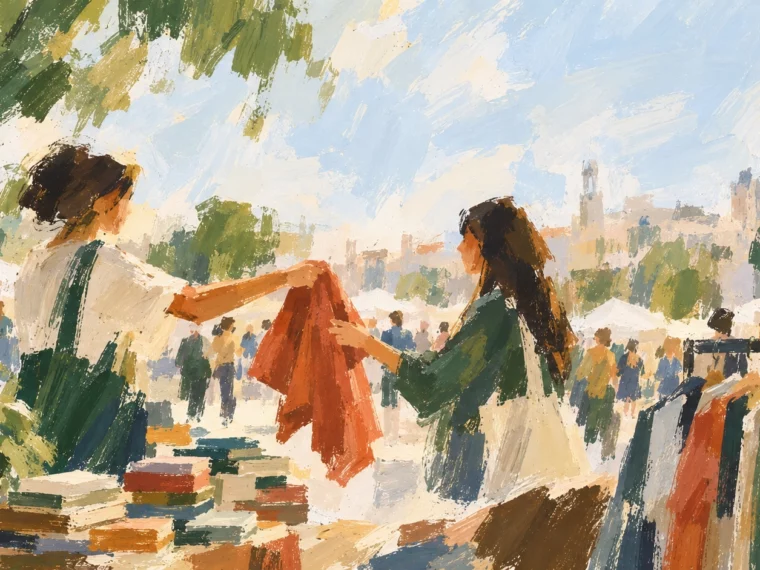
Portuguese association Let’s Swap will be holding one of its swap events at Praça da República.
You can bring up to five items of clothing and five books, with a participation fee of €1.
The event is confirmed on Let’s Swap’s own calendar, although at the time of writing it does not yet appear on Greenfest’s provisional programme.
If you have clothes in good condition that no longer work for you, this is an opportunity to put them back into circulation — and perhaps go home with something that suits your current wardrobe better.
Second-hand clothing pop-up — EcocircularRoute
Friday, Saturday and Sunday, from 11:00
If you would rather browse than swap, there is something for you too.
EcocircularRoute will have a second-hand clothing pop-up in the CERCI Braga area throughout all three days of Greenfest.
The pop-up starts at 11:00 and runs throughout the day.
A conversation about upcycling
Saturday, 17:00
Saturday’s programme also includes a session entirely dedicated to upcycling.
The principle is closely connected to both swapping and second-hand fashion: making use of what already exists.
With upcycling, however, an item or material that might otherwise lose its usefulness is transformed into something with a new purpose or added value.
The session takes place at 17:00 on the Palco Verde (Green Stage).
The vital role of urban trees in the cities of the future
Saturday, 12:00
A more sustainable city is about much more than consumption.
Saturday’s programme also includes a talk about the importance of trees in urban spaces and the role they can play in the cities of the future.
The session starts at 12:00 on the Palco Verde (Green Stage).
Clothes you no longer wear? Bring them along
This is probably the activity that interests us most at Roupeiro.
Let’s Swap events are designed as an alternative to simply buying more things. Instead of leaving an unwanted piece of clothing forgotten at the back of a wardrobe, you can put it back into circulation and give someone else the chance to use it.
At Greenfest, participants can bring up to five pieces of clothing and five books.
At Let’s Swap events, items are normally checked when you arrive to make sure they are suitable for continued use. Accepted items are generally converted into points, which can then be used to choose other clothes or books available at the swap.
The organisation notes, however, that the exact rules may vary when it takes part in events organised by third parties.
As a general rule, clothes should be clean and in good condition, without stains, tears or excessive wear.
Items that Let’s Swap does not normally accept include underwear, promotional clothing and shoes. Certain types of books, including school textbooks and religious books, are also excluded.
There is also an interesting idea behind the limit on how much you can bring.
Second-hand fashion can still become a form of overconsumption. The aim is not simply to replace buying too many new clothes with accumulating too many used ones, but to encourage a more considered relationship with what enters and leaves our wardrobes.
Second-hand fashion throughout the weekend
The swap is not the only opportunity to find clothes that have already had a first life.
The EcocircularRoute second-hand pop-up will be at Greenfest on Friday, Saturday and Sunday, starting at 11:00 in the CERCI Braga area.
Having both options at the same event is a useful reminder that there is no single way to participate in a more circular economy.
You can swap something you no longer wear for something else. You can buy an existing piece instead of choosing new. You can transform something you already own.
Or you can simply decide that you do not need to take anything home at all.
When a piece of clothing does not have to be at the end of its life
Saturday’s upcycling conversation introduces another possibility.
Something that no longer works in its original form does not necessarily need to be thrown away.
A garment can be altered. Fabric can become something else. A material that appears to have no further use can be given an entirely new purpose.
This is particularly relevant when it comes to clothing.
Sometimes we stop wearing something because we no longer like the cut, because one area is damaged or simply because it no longer fits our style.
That does not mean the entire garment — or the material it is made from — has lost its value.
Between swapping, repairing, reusing and transforming, there are plenty of possibilities before the bin becomes the only option.
More than a sustainable shopping market
Greenfest also includes an Eco-Market, bringing together brands and projects working in sustainability.
It is an opportunity to discover alternatives and see what different organisations are doing. But perhaps one of the most useful messages from an event like this is that more sustainable consumption does not necessarily mean buying a product labelled as sustainable.
Sometimes it means buying better.
Sometimes it means buying second-hand.
It can mean swapping.
It can mean repairing, transforming or simply using what you already own for longer.
Three days to explore different choices
Greenfest goes well beyond fashion and the circular economy.
The programme also includes activities focused on biodiversity, food, recycling, wellbeing and citizenship, as well as games and workshops for children and families. Friday also includes activities aimed specifically at schools.
The organisers describe Greenfest as a meeting point for citizens, businesses, institutions and projects interested in sustainability. In 2026, the festival takes place exclusively in Braga, bringing that conversation to Praça da República for three days.
For us, there is an easy Greenfest itinerary to imagine.
Open your wardrobe before leaving home. Pick out a few good-quality pieces you no longer wear. Take them to the Let’s Swap event. Browse the second-hand pop-up. Stop by the upcycling conversation.
And perhaps return home not only with something different, but with a different way of looking at what you already have.