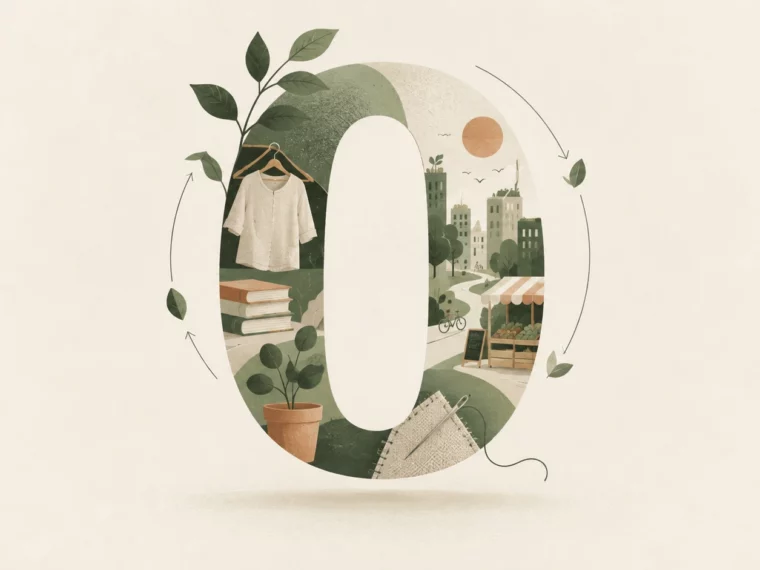
What would it be like to live in a truly sustainable city? That is the question behind Cidade do Zero, which returns to Lisbon on 19 and 20 September. With talks, workshops, repairs, responsible brands and a market where visitors can swap clothes, books and plants, the two-day event offers a chance to discover and try out alternatives for a less wasteful everyday life.
On 19 and 20 September, Lisbon’s Eduardo VII Park will be transformed into a small city dedicated to sustainability.
When: 19 and 20 September
Where: Eduardo VII Park, Lisbon
Opening hours: 10am–7.30pmAdmission to the event is free. Participation in the Swap Market costs €1 per person.
Language: Talks and demonstrations will be held in Portuguese, but the programme also includes plenty of activities that can be enjoyed beyond the talks themselves.
This is the fourth edition of Cidade do Zero, an annual event launched in 2022 to show, in practical terms, what a more sustainable and inclusive city could look like. After previous editions at Pavilhão do Conhecimento, Centro Cultural de Belém and Tapada da Ajuda, the event moves to Eduardo VII Park for the first time this year.
The idea is not simply to talk about sustainability in theory. Over the course of two days, the programme combines talks and discussions with workshops, demonstrations, showcookings, family activities, repair sessions and different approaches to consumption and the circular economy. Admission is free.
A city for trying out different choices
At Cidade do Zero, sustainability is applied to different areas of everyday life: from food and mobility to energy, the home and, of course, the way we buy and use the things we own.
One area of the event is dedicated to a market featuring more than 100 Portuguese brands, across categories including fashion and accessories, home and wellbeing, food, family, services, mobility and circularity.
But buying something is not the only option.
The event also explores alternatives to the buy-use-discard model. There will be second-hand shopping, repair workshops and a Swap Market — all based on a fairly simple idea: before replacing something, perhaps we can extend its life, repair it or pass it on to someone else.
Clothes sitting unworn in your wardrobe? Bring them along to swap
For anyone with items in good condition that are no longer being worn, the Swap Market, organised by Let’s Swap, is likely to be one of the most interesting parts of the event.
And it is not just about clothes.
Visitors can bring clothes and accessories, books and plants, provided they meet the conditions set by the organisers. Each person can bring, per day, up to three items of clothing or accessories, three books and three plants.
Clothing must be in good condition and suitable for someone else to wear. Items with stains, tears, loose seams, a musty smell or excessive signs of wear will not be accepted, nor will promotional clothing. Shoes, underwear, pyjamas, bikinis and swimsuits are also excluded.
The rule for books is similarly straightforward: they must be in good condition. Schoolbooks, religious books, very old or badly damaged books and publications originating from magazines will not be accepted.
Plants must be brought already planted in a container — cuttings alone will not be accepted.
Participation in the Swap Market costs a symbolic €1 per person, helping to support Let’s Swap with the organisation, production and logistics required to run the space.
The idea is to bring something that is no longer useful to us but could still be valuable to someone else — and, in return, see whether something brought by another participant makes sense to take home.
Repair before replacing
Swapping is not the only way to extend the life of the things we own.
Cidade do Zero also includes repair workshops, giving space to a practice that was once a normal part of everyday life but has become less common with the rise of fast consumption: trying to fix something before buying a replacement.
The organisers use examples as different as sewing on a missing button and repairing a broken toaster to illustrate the idea. Repair therefore sits alongside second-hand shopping and swapping as one of the circular-economy approaches explored at the event.
When it comes to clothing, this is particularly relevant. A garment with a small defect has not necessarily reached the end of its life. Sometimes a simple stitch, repair or alteration is enough to keep it in use for much longer.
Not everything new has to be brand new
Perhaps that is one of the most interesting ideas behind Cidade do Zero: bringing together, in one place, different ways of meeting our everyday needs.
We can buy from a brand trying to produce more responsibly. We can shop second-hand. We can swap something that no longer works for us. We can repair what we already own. And we can also come to the conclusion that we do not need anything at all.
For anyone particularly interested in fashion and consumption, the Swap Market makes this idea especially tangible. That piece sitting unworn at the back of the wardrobe may not have lost its value — it may simply no longer make sense for the person who originally bought it.
Before thinking about what is missing from our wardrobe, it may be worth taking another look at what is already there.