For decades, our relationship with packaging followed a simple pattern: buy, use, and throw away. Fortunately, that mindset is beginning to change.
If you’ve lived in countries such as Germany, the Netherlands, Norway or other parts of Europe, you’ll probably already be familiar with deposit return schemes. Returning empty bottles and cans for a refund has been part of everyday life there for years.
Now, Portugal is joining them with the launch of Volta, a nationwide deposit return scheme for PET plastic bottles and aluminium cans.
While it may seem like just another recycling initiative, Volta represents something much bigger. It’s an important step towards a circular economy, where materials retain their value and are reused instead of becoming waste.
One of the most interesting examples of this circular approach can be found in an unexpected place: sustainable fashion.
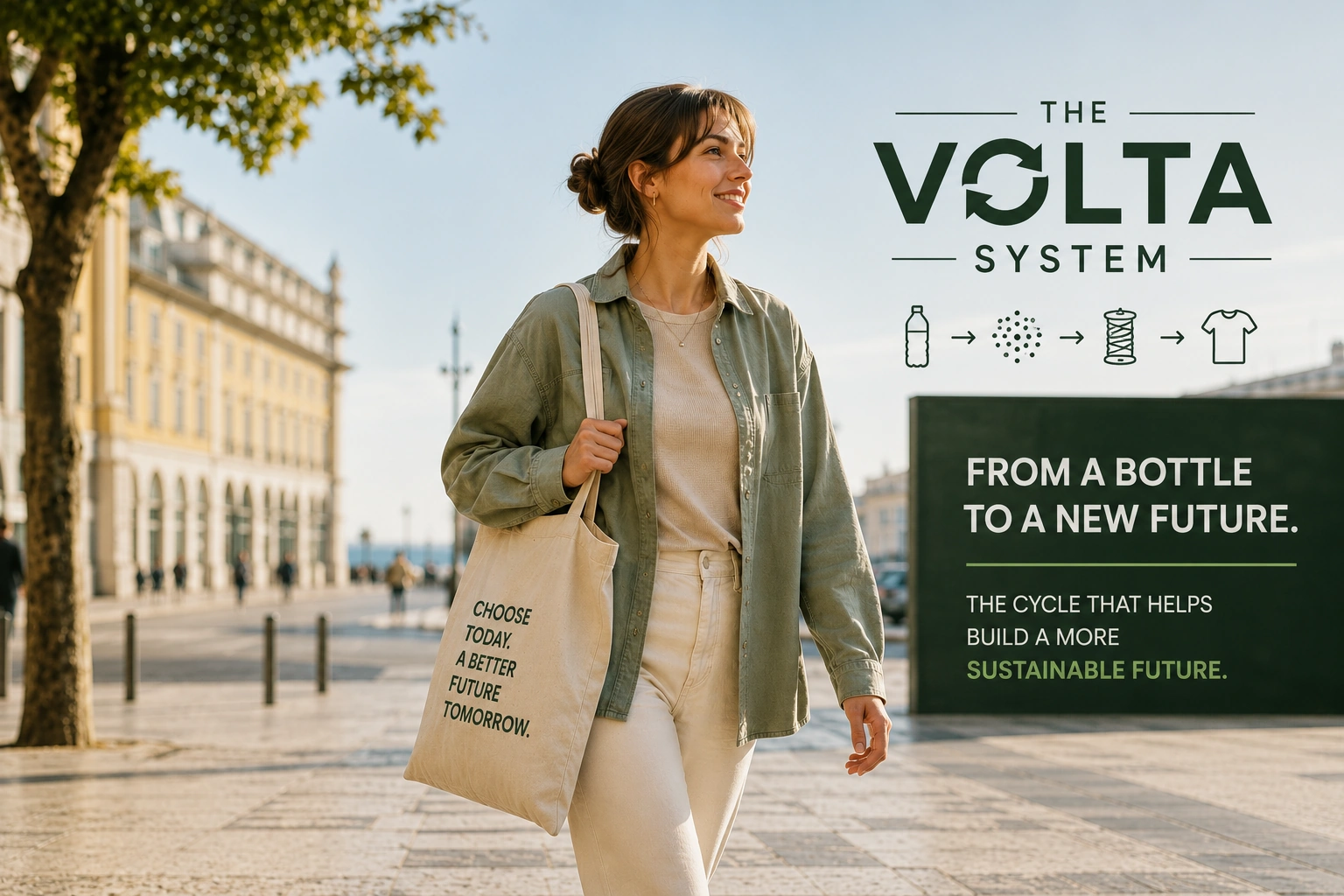
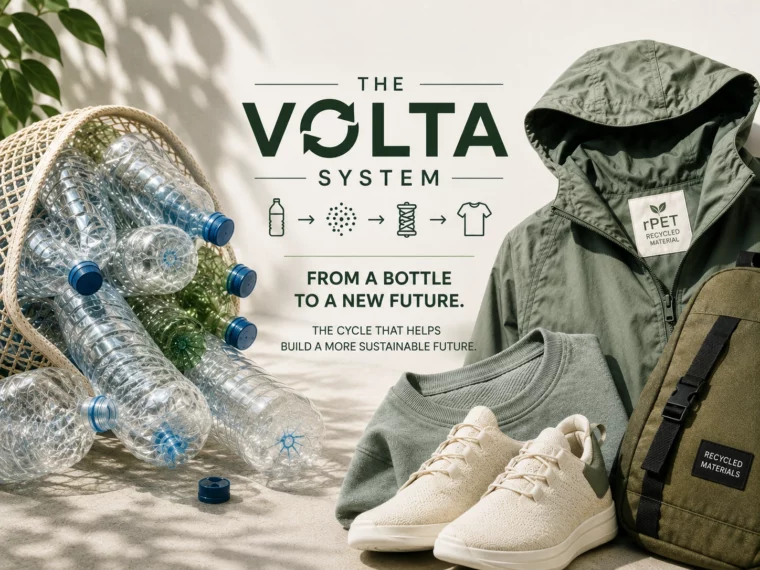
The plastic bottle you return today could become the fabric used to make tomorrow’s jacket, backpack or pair of trainers.
What is the Volta system?
Volta is Portugal’s new deposit return scheme (DRS).
When you buy eligible drinks in PET plastic bottles or aluminium cans, you’ll pay a small refundable deposit. Once you’ve finished your drink, you simply return the empty container to a participating collection point and receive your deposit back.
If you’re Dutch or German, as an example, this process will feel very familiar. For others, it’s a new habit—but an easy one to adopt.
Although it may look similar to conventional recycling, there’s one important difference: the quality of the materials that are recovered.
Why does cleaner plastic matter?
Traditional recycling systems often collect all recyclable materials together. As a result, plastic bottles can become contaminated by food waste, liquids or other materials, reducing the quality of the recycled plastic.
Volta helps solve this problem because:
- bottles and cans are collected separately;
- they arrive at recycling facilities much cleaner;
- and the recovered material retains far greater value.
This is especially important for PET, the plastic used to manufacture most beverage bottles.
When collected in good condition, PET can be recycled into rPET (recycled PET) that’s suitable for much higher-quality applications—including new food-grade packaging and textile production.
How rPET is giving plastic a second life
When PET bottles are collected in good condition, they can be recycled into rPET (recycled PET)—a high-quality material that can be used in a wide range of products.
One of its most important uses is the production of new food and beverage bottles, helping to create a truly circular packaging system. But rPET is also widely used in the manufacture of:
- clothing and footwear;
- sportswear and outdoor equipment;
- backpacks and luggage;
- automotive components;
- household products;
- packaging;
- and even construction materials.
One of the best-known examples is sustainable fashion, where recycled PET is transformed into fibres used to make jackets, trainers, swimwear and other garments.
The benefits are significant. Using rPET reduces the need for virgin plastic made from fossil fuels while giving valuable materials a second life instead of sending them to landfill or allowing them to reach rivers and oceans.
Instead of a linear economy—produce, use and dispose—we move towards a circular one:
Bottle → recycled material → new product → recycled again
This is what makes systems like Volta so important. The cleaner the bottles collected, the higher the quality of the recycled material, allowing it to be used in more demanding applications, including new food-grade packaging and high-performance textiles.
Sustainability is more than recycled plastic
Of course, recycled PET isn’t a perfect solution.
It’s still a synthetic fibre, and important challenges remain, including:
- microplastic pollution;
- overconsumption;
- fast fashion;
- and textile waste.
However, sustainability isn’t achieved through a single breakthrough.
It’s built through thousands of incremental improvements, including:
- more circular materials;
- more efficient manufacturing;
- repairing instead of replacing;
- reusing products for longer;
- and improving how we recover valuable resources.
Volta is one of those improvements.
The challenges ahead
Like any new nationwide system, Volta will face some initial challenges.
These include:
- encouraging people to change their recycling habits;
- expanding the number of collection points;
- managing logistics;
- covering operational costs;
- and helping consumers understand how the scheme works.
This adjustment period is entirely normal. Countries such as Germany, Norway and the Netherlands all experienced similar transitions before deposit return schemes became second nature.
Today, these countries achieve some of the highest beverage container return rates in Europe, allowing cleaner materials to be recycled more efficiently and reducing the amount of plastic that becomes waste.
Every bottle returned is a small action—but multiplied millions of times, the impact is considerable.
Changing the way we think about waste
Perhaps Volta’s greatest contribution isn’t technological or financial.
It’s cultural.
For decades, we viewed packaging as something disposable.
Volta encourages us to see materials differently.
Instead of reaching the end of their life after a single use, bottles and cans become valuable resources that can re-enter the production cycle.
That same way of thinking naturally extends beyond packaging.
It encourages us to:
- buy less;
- choose better-quality products;
- reuse what we already own;
- recycle responsibly;
- and extend the lifespan of clothing and everyday items.
Sustainable fashion isn’t simply about choosing eco-friendly fabrics.
It’s about creating smarter systems that keep valuable materials in use for as long as possible.
In many ways, that’s what Volta represents.
It’s not a perfect solution—but it is an important step towards a Portugal where fewer resources are wasted and where yesterday’s bottle could become tomorrow’s jacket.