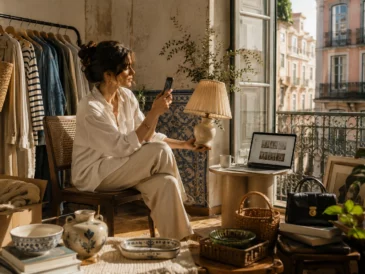
Five second-hand stops through Baixa, Chiado and Mouraria — with plenty of Lisbon in between
One of the best ways to explore Lisbon is to give yourself a reason to walk.
This route does exactly that: five vintage and second-hand shops become the thread connecting some of the city’s most interesting central neighbourhoods. Starting around Baixa, touching some of other iconic parts touching Chiado and Mouraria. The walk moves through the historic centre before ending in Mouraria, with a coffee — and one spectacularly oversized plant — waiting at the end.
The shops are deliberately different. Some are about the thrill of finding something unexpected; others are more carefully curated, designer-focused or wonderfully eclectic. Together, they make a good introduction to Lisbon’s second-hand fashion scene.
But don’t think of this as a shopping checklist.
The route is best enjoyed slowly. Allow time to browse, stop for a coffee, look inside old shop windows, admire the tiles and take the occasional wrong turn. Lisbon is a city where the journey between two addresses can be as interesting as the destination. The route is made to apreciate the shopts and the cityl
So, comfortable shoes on, tote bag ready, and let’s go.
1. Amor Fati — start with pieces that already have a story
Rua Almirante Pessanha, 6 — Chiado
Begin at Amor Fati, a vintage store built around the idea that finding something special is partly a matter of luck — or, perhaps, fate.
The name itself comes from the Latin expression amor fati, usually translated as “love of fate”. It is a fitting name for a second-hand shop: you never quite know what will be waiting for you on the rail.
The strength of Amor Fati is its personal, approachable curation. Rather than feeling like a warehouse of clothes, the selection is chosen with an eye for pieces that stand out while still being wearable. Vintage and second-hand clothing sit alongside shoes and accessories, with the emphasis on finding good-quality pieces with personality. Visitors often highlight the careful selection, condition of the clothes and the possibility of finding designer labels without the price tag of a new purchase.
This is the sort of shop where you should allow yourself to browse without a plan.
Maybe you’re looking for a jacket. Maybe you leave with a pair of shoes. Maybe the best thing you find is a piece you hadn’t realised was missing from your wardrobe.
That’s part of the appeal of vintage.
The neighbourhood: Chiado
You’re starting in one of Lisbon’s most elegant and lively neighbourhoods.
Chiado has long been associated with culture, shopping and city life, with theatres, bookshops, cafés and independent stores woven into its historic streets. It sits between Baixa and Bairro Alto, making it an easy place to begin exploring on foot.
From here, take your time heading towards the next stop. Largo do Carmo is close by and worth a detour, particularly for the atmospheric ruins of the Carmo Convent.
This is one of those parts of Lisbon where simply walking is enough of an activity.
2. POP Closet — second-hand with a designer eye
Rua Garret 19 (patio siza Vieira) loja A – Chiado
Next comes POP Closet, a very different kind of second-hand shopping experience.
If Amor Fati is about discovering something unexpected, POP Closet is more about curated fashion and designer labels. The shop has established itself as a destination for pre-owned contemporary and luxury fashion, with brands such as Loewe, Dior, Saint Laurent, Acne Studios and Off-White among the names that have featured in its selection.
The appeal here is obvious if you like fashion but don’t necessarily want to buy new.
A pre-owned designer piece can have all the things that make luxury fashion appealing — good materials, interesting construction, recognisable design — while giving an existing garment another chapter instead of adding another newly produced item to your wardrobe.
The shop’s strength is therefore curation. You don’t have to dig through mountains of clothing. The pleasure comes from seeing what has been selected and spotting the piece that feels worth taking home.
It’s also a useful reminder that sustainable fashion doesn’t have to mean abandoning fashion altogether.
Sometimes it means changing where you look.
The neighbourhood: Chiado to Baixa
As you leave Chiado, the city begins to open up towards Baixa.
The contrast is striking. Chiado’s more intimate streets give way to the grand, geometric layout of the Pombaline centre, rebuilt after the devastating earthquake of 1755.
This is the Lisbon of Rua Augusta, Rossio and Praça do Comércio, but there is more to Baixa than its main tourist routes. Look down the side streets and you’ll find traditional shops, old façades and businesses that have survived alongside the newer city.
Keep walking.
Your next stop takes you deeper into this historic centre.
3. A Outra Face da Lua — vintage with a real sense of history
If there is one shop on this route that feels like a lesson in why vintage matters, it is A Outra Face da Lua.


Established in Baixa in 2005, the shop has built its identity around vintage clothing as an alternative to the constant cycle of buying new. Its selection spans several decades, particularly from the 1960s through the 1990s, and includes clothing and accessories for both women and men.
The strength here is authentic vintage.
Rather than simply selling clothes that happen to be second-hand, the shop is interested in pieces from particular periods, with their own silhouettes, fabrics, labels and histories.
That makes browsing more interesting. A dress isn’t just a dress: it might belong unmistakably to a particular decade. A jacket might have a cut that you simply don’t see in today’s high-street shops.
And that is one of the pleasures of vintage shopping — discovering that fashion history can still be part of your everyday wardrobe.
The neighbourhood: Baixa Pombalina
Baixa is Lisbon’s great central stage.
Its wide streets and orderly grid were created as part of the reconstruction of the city after the 1755 earthquake. The result is unlike almost anywhere else in Lisbon: relatively flat, symmetrical and monumental.
Take a moment to walk towards Praça do Comércio if you have time. The river is just beyond it, and the enormous square is one of the best places to appreciate the scale of the reconstruction.
For this route, however, we’re heading in another direction.
Continue towards Rua da Conceição.
4. Ás de Espadas — when vintage gets playful
Rua da Conceição, 117–119 – Baixa

Now for Ás de Espadas, on Rua da Conceição.
This is where the route becomes particularly fun for anyone who likes clothes with a little more attitude.
Ás de Espadas is known for its vintage selection and its strong sense of personality. The shop’s offer stretches across different decades, with a particular affinity for the 1960s and 70s, while also bringing in pieces from later periods. The Rua da Conceição shop carries both women’s and men’s clothing, as well as accessories.
The strength here is character.
Expect to find pieces that can change the mood of an outfit rather than simply replace something basic in your wardrobe: vintage dresses, leather, shirts, jackets, accessories and the kind of statement pieces that make you wonder why you don’t dress like this every day.
This is a good shop to visit when you are trying to move away from the idea that sustainable fashion means making your wardrobe boring.
Quite the opposite.
Buying second-hand can be an excuse to become more experimental.
The neighbourhood: Rua da Conceição and Baixa
Rua da Conceição is part of the quieter side of the Baixa grid, away from some of the busiest tourist routes.
It is a street to explore slowly, with traditional businesses and older commercial façades sitting alongside newer independent shops.
Look around as you walk. Lisbon’s historic centre is full of details that are easy to miss when you’re moving from one attraction to the next: tiled entrances, old signs, balconies and tiny shops that have been part of the neighbourhood for decades.
From here, the route gradually moves east.
And the city starts changing again.
5. Tropical Bairro — finish with vintage, vinyl and a little colour
Rua de São Cristóvão, nr 3 – Mouraria

The final stop is Tropical Bairro, and it might be the most entertaining of the five.
Part vintage shop, part record store, it brings together two things that work surprisingly well: clothes and music.
The shop has a particularly eclectic feel, with vintage clothing alongside a large selection of second-hand vinyl. Its fashion selection has a strong Italian influence, while the records cover an impressively broad range of sounds — from Brazilian and Latin music to jazz, soul, funk, rock, electronic music and Portuguese music.
The strength of Tropical Bairro is its sense of discovery.
You might go in looking for a shirt and end up flipping through records for half an hour.
You might find a colourful vintage jacket, a printed shirt or a piece that feels like it belongs in a different decade. Or perhaps you’ll find the soundtrack for the walk home.
The shop was created by DJ Paolo Dionisi, which helps explain why music feels so central to the experience. Here, vintage isn’t treated as something precious or museum-like. It is part of everyday culture — something to wear, listen to and live with.
Which makes it a very appropriate place to finish a vintage shopping walk.
The neighbourhood: Baixa to Mouraria
By now, you will have noticed the city changing.
Rua de São Cristóvão sits at the eastern edge of Lisbon’s historic centre, where Baixa gradually gives way to Mouraria. Mouraria feels narrower, older and more layered than Baixa. Its streets climb and twist, and its multicultural character is particularly visible in the restaurants, grocery shops, cafés and small businesses that fill the neighbourhood.
It is also deeply connected to the history of fado, and the area around São Cristóvão has some particularly atmospheric streets.
The Castelo de São Jorge is just uphill, while the Igreja de São Cristóvão e São Lourenço is close to Tropical Bairro.
But this is not really the moment to start ticking off landmarks.
You’ve reached the best part of the walk.
Slow down.
Coffee, a giant plant and the perfect end to the walk
Stay on Rua de São Cristóvão after leaving Tropical Bairro and find somewhere to sit down for a coffee.
The street itself is worth lingering on. Narrow, slightly uneven and lined with old buildings, it has the lived-in quality that makes Mouraria so appealing. There are small businesses at street level, tiled façades above them and the castle looming somewhere up the hill.
And then there is the plant.
One of Mouraria’s most unexpected sights is a giant plant growing between the buildings on Rua de São Cristóvão. Rising several metres above the street, it has become something of an unofficial local landmark — the kind of thing you would never think to put on a sightseeing itinerary, but that you remember afterwards.
It is precisely the sort of detail that makes walking around Lisbon so rewarding.
You leave the house looking for second-hand clothes and end up drinking coffee beneath an enormous plant.
There is something very Lisbon about that.
And perhaps that is the best lesson from a slow-shopping afternoon: you don’t have to buy much to discover a lot.
Five shops, several neighbourhoods, a handful of unexpected finds and a few hours on foot are enough to see a different side of the city — one where sustainability, style and everyday Lisbon life naturally overlap.